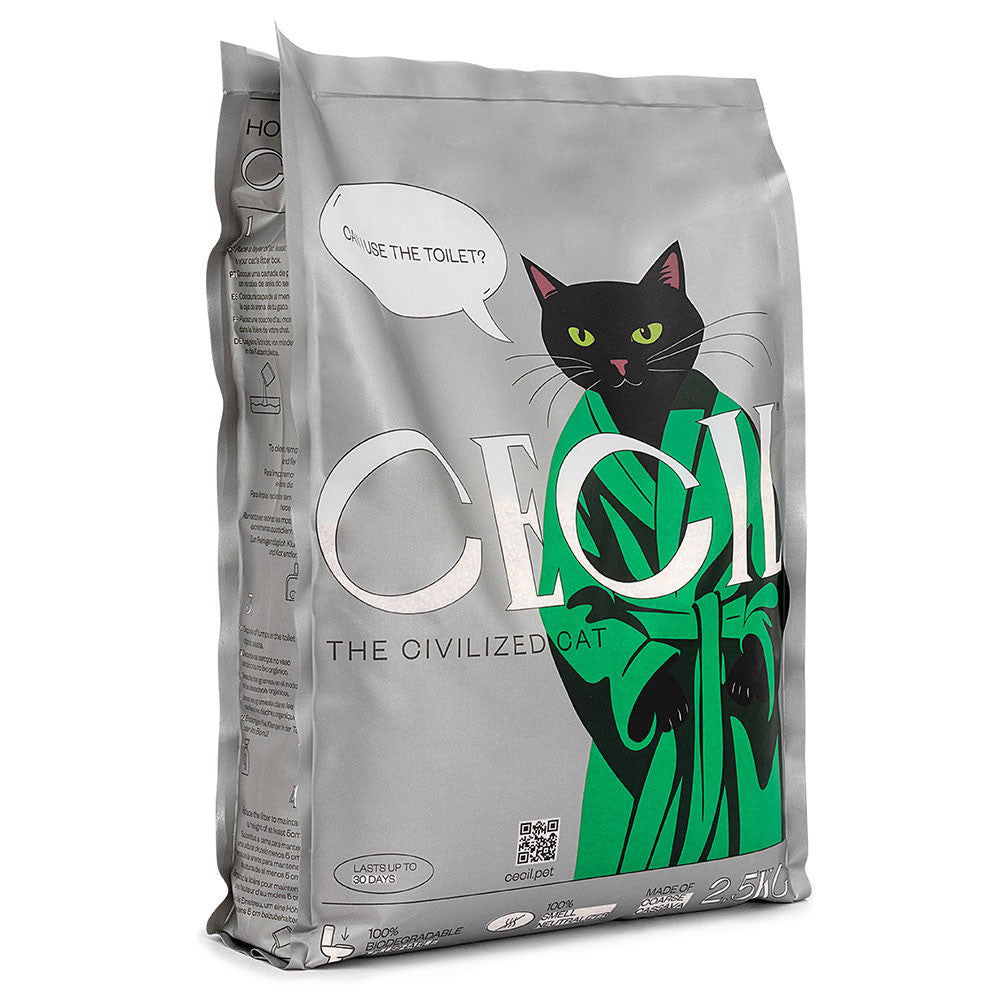
Cecil Natural Cassava Vegetable Litter is a practical, sustainable, and highly efficient solution for feline daily hygiene. Made from 100% natural cassava, this vegetable litter offers an eco-friendly alternative to traditional litters, ensuring high absorption, excellent odor control, and greater comfort for the animal.
Its hypoallergenic and toxic-substance-free formula makes it ideal for more sensitive cats, helping to create a healthier home environment. Furthermore, it contains no cement and produces no dust, contributing to cleaner and more comfortable use for both the cat and the family.
Thanks to its high absorption power, the litter forms compact and light clumps upon contact with urine, facilitating daily removal and reducing waste. Its natural ability to inhibit bad odors keeps the litter box fresh for longer.
The 2.5 kg package offers surprising performance, lasting more than 40 days, depending on the number of cats and frequency of use. Equivalently, 2.5 kg of this vegetable litter corresponds approximately to the yield of 10 kg of traditional bentonite litter, taking up much less storage and transport space.
FEATURES
- Made with 100% natural cassava
- Hypoallergenic
- 100% vegetable substrate
- Biodegradable
- Very absorbent
- Excellent odor control
- Forms compact clumps
- Dust-free
- Non-toxic
- Practical and compact
- High yield
- Can be flushed down the toilet
- Sustainable alternative to traditional litters
Sustainable from start to finish
Cecil Litter is produced with 100% vegetable and biodegradable substrate. From raw material to disposal, it has been developed to minimize environmental impact. After use, waste can be flushed down the toilet in small quantities.
How to use
- Fill the litter box with 1 full 2.5 kg bag
- Remove clumps and solid waste daily
- Replenish the amount of litter as needed to maintain the ideal level
- No full replacement is necessary, as the litter is 100% odor inhibiting and ultra-hygienic
Particle behavior in water and the toilet
Cassava particles have been developed to naturally break down with prolonged contact with water. When flushed in small quantities down the toilet, they begin to absorb water, gradually soften, and eventually decompose, facilitating dissolution and reducing environmental impact.
Nevertheless, it is recommended to flush small quantities at a time, especially in older or sensitive plumbing systems.